
Every finished construction project hands over two versions of the same building. One lives digitally, in the plans and drawings. The other physically stands on site, shaped by hundreds of decisions made along the way.
From a distance, the two may look the same, but the differences appear in the details. A pipe rerouted around a beam, a wall moved to make room for a riser, a specification changed on site to keep the project on track. The decisions are valid and rational in the moment, but the question is, does the digital record still accurately reflect what happened?
Every approval and handover depends on being able to understand what was built and why. Today, project and quality managers need that understanding to make decisions with confidence. Years after handover, someone else may need to know what lies behind the same wall.
Reality capture has long given construction teams an accurate view of site conditions at important moments. But as capture becomes faster and easier to incorporate into everyday site work, a different possibility emerges: Does reality capture need to solely rely on the next milestone?
What Happens Between Construction Milestones?
Quite a lot, it would seem. Milestone scanning is, of course, important because it creates a very detailed record of the site at key stages of the project. However, construction does not move in milestones. It moves every day. Between one milestone and the next:
- Work progresses and the site continues to change.
- Installations are completed and concealed behind walls, ceilings, and finishes.
- On-site decisions become part of the finished building.
- The previous capture becomes less representative of current conditions.
These changes may happen gradually, but together they create an important question: how closely can the project record keep pace with the project itself?
Can Scanning Keep Project Records Aligned?
For scanning to become an everyday activity, it must fit the way people already move through a site. Rovi i.1 is designed around that idea.
Making Capture Part of the Routine
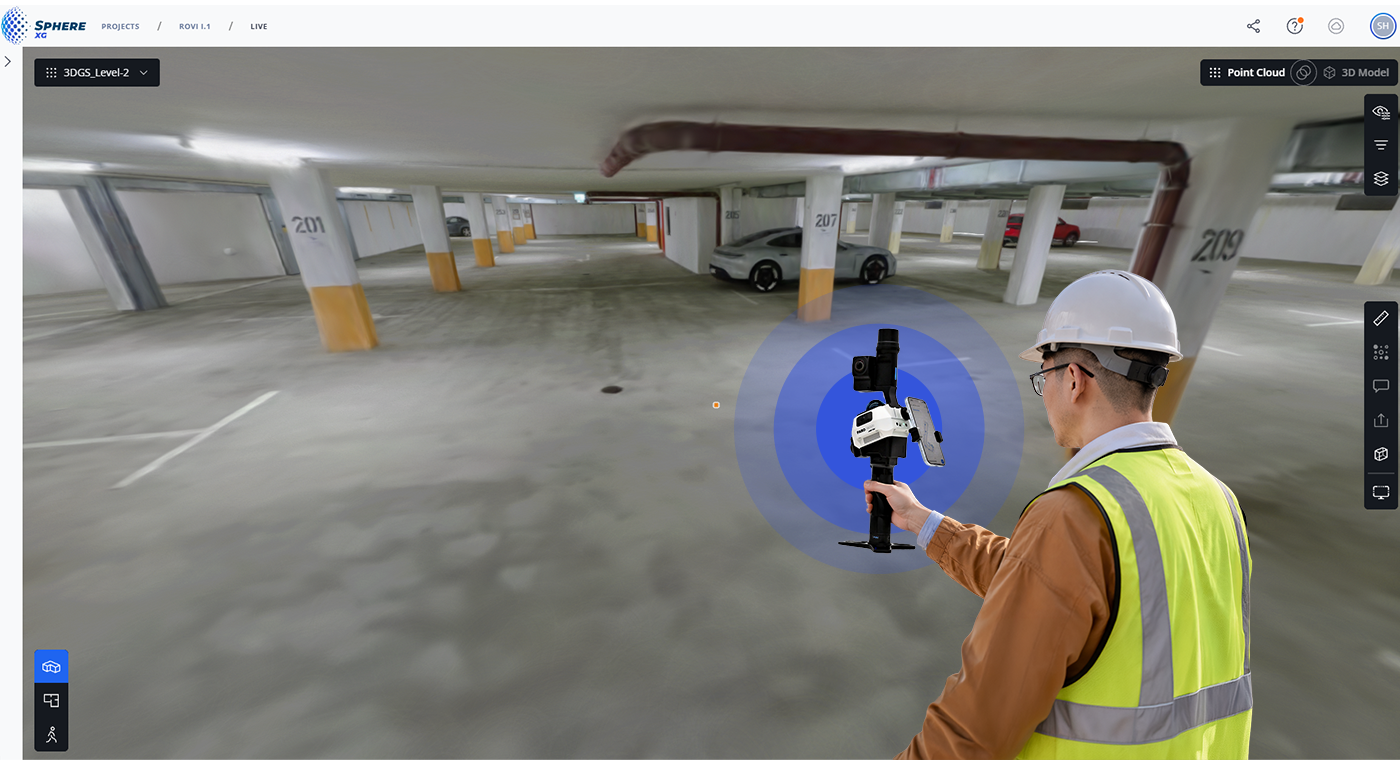
Developed with Manifold3D, the complete reality capture solution combines a mobile laser scanner with FARO Sphere® XG and SCENE, in one neat package. The easy-to-use scanner unlocks the opportunity for more people to be involved in data capture by simply walking and scanning.
With this level of simplicity, the real value isn’t in individual scans. It emerges when they build on one another. Each capture adds another point in the project's history, allowing teams to:
- Compare conditions with plans over time.
- Review how work has progressed.
- Return to earlier stages after something has been covered or changed.
- Turn individual snapshots into an evolving record of the project.
From Capture to Decision in Sphere XG
Frequent site capture is only valuable if people can use the data. As the record becomes more current, the next challenge is making that information available to the people who need to understand what has changed and decide what happens next. The sooner a scan reaches the people accountable for making decisions, the closer their understanding stays to reality.
Sphere XG connects that capture workflow with the wider project team. Scans, 360° imagery and 2D images are available, together, in a cloud-based environment and viewed through a web browser, giving stakeholders access, and a holistic view, of the captured site conditions. As new captures are added, the shared reference becomes more valuable:
- Project managers can review progress against plans.
- Design teams can check proposals against existing conditions.
- Quality managers can return to earlier captures to see what was installed and when.
Over time, those captures create something no single survey can provide on its own: a visual history of how the site changed. Teams can return to earlier conditions, understand what was present at a particular point and follow the building's development rather than reconstructing it later from separate records and recollections.
Confidence at Every Handover
The benefit builds with every capture. During construction, a more current record gives teams greater context for the decisions in front of them. At handover, those same captures become the history of how the finished asset took shape.
By handover, everyday captures have accumulated into something much bigger than a series of scans: a record of how the asset was built. Owners and facilities teams begin with more context about what exists, what changed and, where conditions were captured before they were concealed, what sits behind the finished surfaces.
Closing the Gap
A building may stand for generations, but the people who designed it, built it, and shaped it will move on. What remains is the asset and the record they created along the way.
A useful record is not created at handover. It is built throughout the project, one capture at a time. The more closely it evolves with the building, the more future teams can understand about what exists and how it got there. So, when the keys finally change hands, how much of the building’s history do you want to go with them?